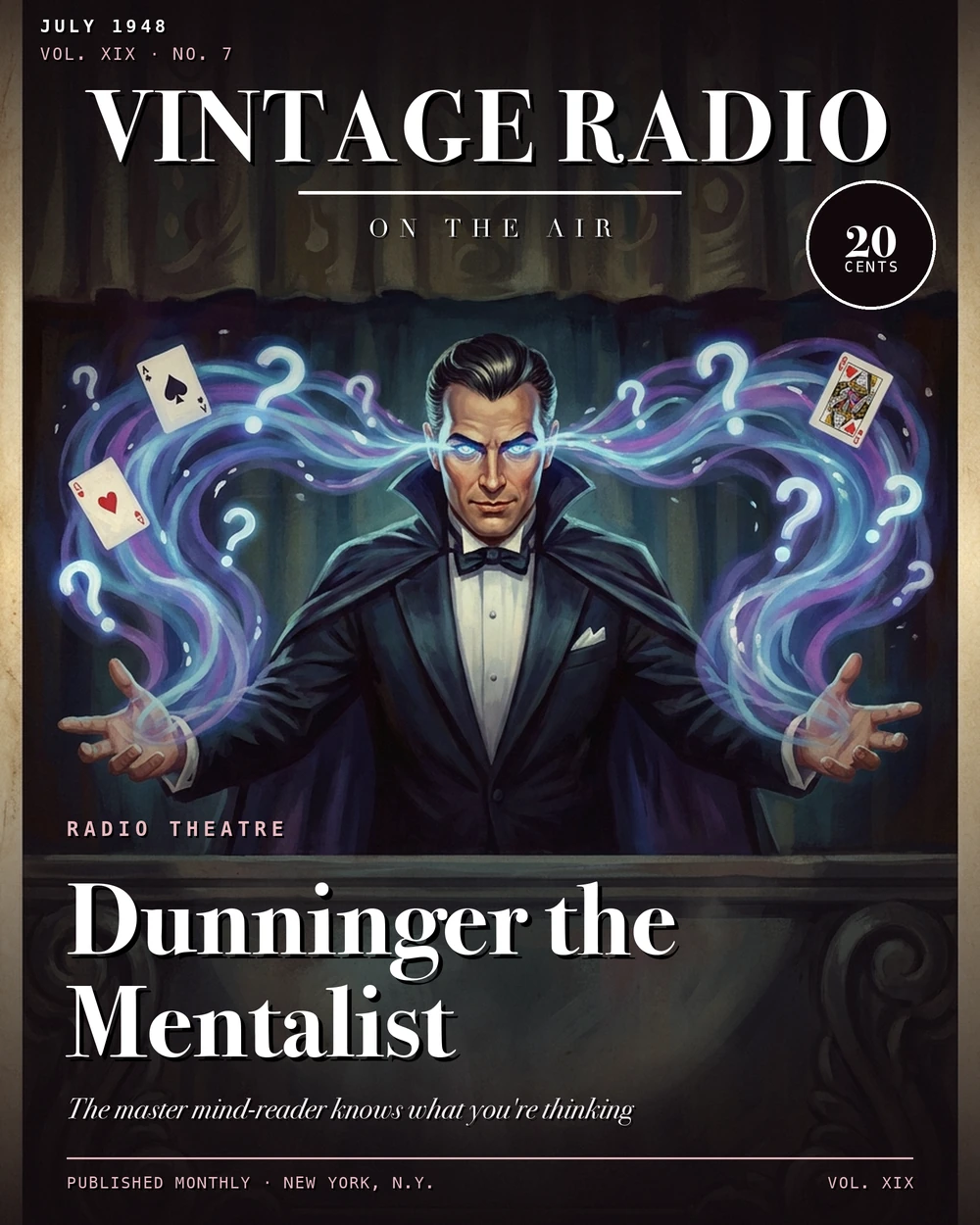
Dunninger the Mentalist
The Strangest Thing Ever to Get on the Air
When Variety reviewed the debut season of Dunninger the Mentalist in November 1943, reporter Earl Sparling put it plainly: "The Dunninger Show is about the strangest thing ever to get on the air." That's a reasonable take. The show's star, Joseph Dunninger, was a magician, hypnotist, and self-described mind reader who had been performing since vaudeville and had already made his first radio appearance for NBC back in 1929. By the time he got his own weekly series — premiering September 12, 1943 on the Blue Network — he had spent decades honing what he called "telesthesia," his term for the practice of reading other people's thoughts. Translating that act to radio was an unusual proposition, and the premiere created what contemporary observers described as a minor sensation.
Dunninger was billed as "the Master Mentalist," and his act on radio followed a consistent structure. Each program began with random readings from the studio audience — birthdays, names, addresses — before progressing to more elaborate stunts as the half hour went on. His standard repertoire included identifying objects placed in a box by audience members, revealing telephone numbers or personal information of strangers in the crowd, and reading cards that subjects had written and tucked into their pockets. In the studio, Dunninger sat on a stool in front of the audience, doodling on a piece of paper while he worked. After each successful reading, he dismissed the subject with a brisk "I thank you very much" and moved on.
How the Skeptics Pushed Back
From the start, speculation followed Dunninger about whether the act was genuine or staged. He responded with an approach that was at least theatrically clever: he surrounded himself with what he called "unimpeachable" judges — entertainers, politicians, newspaper editors, and at least one New York Supreme Court justice — who participated in the mind-reading stunts and swore publicly to their authenticity. He also maintained a standing offer of $10,000 to anyone who could prove he used an accomplice. Through Scientific American and the Universal Council for Psychic Research, he later extended a related offer to cover any medium who could produce by psychic means a phenomenon he couldn't reproduce by natural means — a figure he sometimes suggested could go as high as $100,000.
The most pointed public challenge came from Radio Life critic Evelyn Bigsby, who zeroed in on Dunninger's practice of having subjects write down messages before he claimed to read them. Dunninger replied, with some irritation, that the writing act drove subjects to a deeper level of thought. Bigsby shot back that the writing was simply part of a standard magic trick, not telepathy at all. She cited bandleader Richard Himber — who also dabbled in magic — as someone who could replicate the same effect, and Himber followed up by publicly offering $1,000 to prove it before a national radio audience. Dunninger did not respond. He did, however, acknowledge a ceiling on his own claimed powers, conceding that he was right "only 90 per cent of the time" — a line that managed to be both a hedge and a boast at once.
The show also incorporated a theatrical segment in which celebrity guests played characters in a murder mystery skit, presenting Dunninger with what were described as "mental challenges." He would respond to their unspoken questions. Notable audience participants across the run included Dorothy Kilgallen, Roy Acuff, Jack Dempsey, and Irene Rich, along with a longer roster of musicians, writers, and public figures who turned up across different episodes.
The Man Behind the Act
Joseph Dunninger's full name was William Joseph Dunninger. He was born on April 28, 1892, on the Lower East Side of Manhattan, to German immigrant parents — his mother was Jewish, his father Roman Catholic. He died on March 9, 1975, in Cliffside Park, New Jersey, of Parkinson's disease; on the day of his death, the Academy of Magical Arts posthumously awarded him a Masters Fellowship for his lifetime contributions to the field.
Before he became the "Master Mentalist," Dunninger had billed himself "The Amazing Young Dunninger" and performed as a general magician in vaudeville. Over time he dropped magic effects entirely and focused on mentalism — a significant shift, because it meant evolving what had typically been a two-person act into a solo performance. By the time he was seventeen, he had performed at the home of Theodore Roosevelt in Oyster Bay, New York, and at the home of Thomas Edison; both were described as avid admirers. President Franklin D. Roosevelt invited him to the White House on multiple occasions, and on one such visit Dunninger correctly recited the serial numbers on a five-dollar bill from the wallet of Treasury Secretary Henry Morgenthau. Across his career, he performed for six U.S. presidents and for Pope Pius XII.
Dunninger was a close friend of Harry Houdini, and the two shared a commitment to exposing fraudulent mediums. After Houdini's death, Dunninger took up that cause on his own, building a file of some 3,000 investigative cases. His 1935 book Inside the Medium's Cabinet ran to 228 pages and described itself as "a daring expose of fraudulent mediums and the trickery of so-called supernatural phenomena." He had published his first two books — Dunninger's Tricks Deluxe and Dunninger's Tricks Unique — in 1918, when he was twenty-six, and by 1940 had twelve books to his credit along with articles in Scientific American, Popular Mechanics, and Life. He was also friends with Walter B. Gibson, the novelist who created The Shadow radio character; Gibson is believed to have ghost-written books for Dunninger and reportedly drew on him as partial inspiration for The Shadow's ability to "cloud men's minds so they cannot see him."
Dunninger had a self-deprecating line about his own claimed gifts: "Mind reading isn't supernatural. It can be done by a child of three… with 30 years experience." It's a good line — the kind that lets an audience laugh and wonder at the same time.
The Ratings and the Run
The Blue Network run of Dunninger the Mentalist was sponsored by Sherwin-Williams Paints, specifically promoting the company's Kem-Tone brand. The show premiered on Sundays at 6:30, then shifted to Wednesdays at 9 once Sherwin-Williams formally came on as sponsor starting January 5, 1944. The Wednesday slot put Dunninger up against formidable competition: Eddie Cantor on NBC, Frank Sinatra on CBS, and Gabriel Heatter on Mutual — a trio that averaged a combined 38.2 Hooperating points per week. Dunninger pulled a 3.9, placing him 149th overall. The next season was no better; the same competition averaged 40.3 combined points against his 3.3. By the time the first series left the air in December 1944, critics had started calling it repetitious.
The show did considerably better under different circumstances. Rinso — via Lever Brothers — sponsored two subsequent runs, both on NBC and both as summer replacements for Amos 'n' Andy. The first NBC run went from June 8 to September 28, 1945, on Fridays at 10. During those thirteen weeks, Dunninger achieved his best Hooperating of the entire radio series: 8.8. The second NBC run was brief — just four episodes, from June 4 to June 25, 1946, on Tuesdays at 9 — after which his series work in radio ended for good.
Cast members across the run included Marilyn Day, Bill Slater, and Andy Love, with Roger Krupp and Don Lowe handling announcing duties at various points and Mitchell Ayres providing the music. Slater — full name William Ernest Slater, a 1924 West Point graduate who had covered the 1936 Berlin Olympics for NBC — was a seasoned radio presence who later became known as emcee of Twenty Questions and Luncheon at Sardi's. He is also the great-uncle of actor Christian Slater. Ayres had formed his own orchestra in 1937 and built a reputation for what he called "Fashions in Music" — melodic and refined, not hard swing. His orchestra had already scored hits with Bluebird Records and had its own CBS Radio program by 1940. The same year he was working on the Dunninger show, Ayres conducted a demo recording that launched his long association with Perry Como. The Mitchell Ayres Orchestra disbanded in mid-1944, and Ayres went on to a career as a prominent musical conductor for television and Las Vegas engagements before his death in a 1969 street accident in Winchester, Nevada, where he was conducting for Connie Francis at the Landmark Hotel.
After Radio
Dunninger's transition to television came quickly. In 1948 he co-hosted The Bigelow Show on NBC-TV alongside ventriloquist Paul Winchell and his dummy Jerry Mahoney — though the two portions of the program were kept entirely separate, and the performers barely interacted. On that show, Dunninger performed long-distance stunts, including reading the mind of a Congressman in Washington, D.C. from his studio in New York. The program ran on NBC through July 1949, then briefly returned on CBS that October.
He followed that with The Dunninger Show on NBC-TV in 1955 — featuring guest appearances from Buster Keaton, Ilka Chase, and Rocky Graziano — and then moved to The Amazing Dunninger on ABC-TV, which aired from May 9 to October 10, 1956, with Basil Rathbone, Bob Hope, and Walter Slezak among the celebrity guests. His fame during this period was broad enough to generate parody characters: Johnny Carson played "The Amazing Dillinger" on The Johnny Carson Show in 1955, and "Gunninger the Mentalist" turned up as a recurring character on a Soupy Sales program. On the I Love Lucy episode "Ricky's European Booking," Fred Mertz brags to Ricky Ricardo "Just call me Dunninger" after correctly predicting Lucy's reaction — a casual reference that assumed audiences in the mid-1950s would immediately recognize the name.
A final set of programs produced for ABC-TV in 1971 was recorded but never broadcast. By then, Parkinson's disease had progressed to the point where Dunninger could no longer summon the strength of presentation that had made his act work. Nine episodes of the original radio series survive, along with documented guest appearances on programs like We the People — a thin but real cross-section of what made him, for a few years in the 1940s, one of the strangest acts on the air.